is history happening over there?
one of the writers who i think i hope to emulate most is kate wagner. is it obviously in part because she can dramatise road cycling and make people on the internet care about goofy, skinny slovenians, but also because her vast and diverse interests all feel necessary and compelling and unified. i hope one day people understand the many things i care about with a similar sense of their unity, perhaps because i can talk about them with the same conviction. i apologise to kate wagner, the people’s architecture critic, because i am writing about architecture and feeling embarrassed about even trying.
the built environment is a thing that facilitates all of our human practices together, it makes them durable and directs them over time and space in ways that remain solid and intransigent in the face of our whims and petty desires. there are the journeys i want to make, and the journeys that are actually facilitated by the transport network in front of me. sometimes i am fortunate when they line up, sometimes they have nothing to do with each other, and sometimes, like on my regular trip to the library, the route is direct but divergent in a way that is fine to do every day, but just slightly irksome.
(i looked up why U2 in berlin has such a funny shape: it was originally conceived as an east-west elevated line through kreuzberg from warschauer straße, via impoverished neighbourhoods through which they were willing to hang a gargantuan contraption in the sky. tunnels were forbidden because they were thought to rattle the newly installed sewers to bits. it was intended to terminate on a small southern kink to bülowstraße, but after the early success of the scheme and seeking to connect the new rising centers of the city, the first operating pattern was a bizarre triangular arrangement, with trains from the eastern end taking a turn north to the major center at potsdamer platz, then reversing and heading further west to charlottenberg, then back east. eventually the elevated sections in the east were given over to a new line, now U1/3, as having a metro line with a triangular junction in it turns out to be a terrible idea, most obviously because a single missed signal can mean trains crashing into each other. this is what happened in 1908, knocking a carriage off the elevated viaduct and killing 21 passengers. U2 was rerouted to head northeast from potsdamer platz on a major extension and became the famous central trunk connecting berlin’s great centres, from the grand shopping arcades at zoologischer garten in the west through the commercial hub of potsdamer platz to the cultural and cosmopolitan heart of the city in the east, alexanderplatz. whenever i ride u2 heading to the east (i go from zoologischer garten to potsdamer platz whenever i go to the library), i have wondered why its tunnel heads south to bülowstraße, then takes such a sharp 90 degree turn north on an absurdly steep viaduct. i just wish there was a simple east-west route. now i know why it’s like that.)
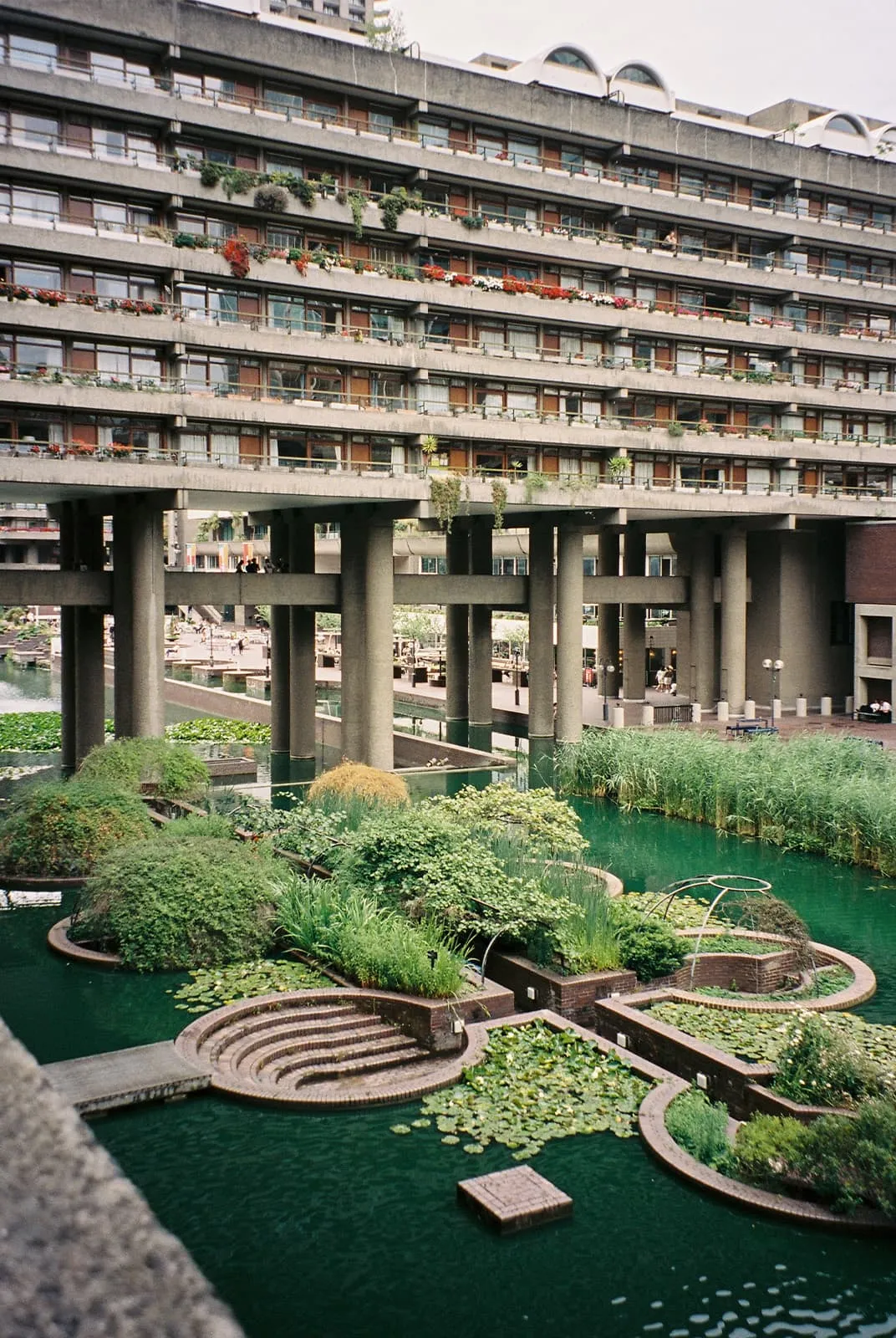
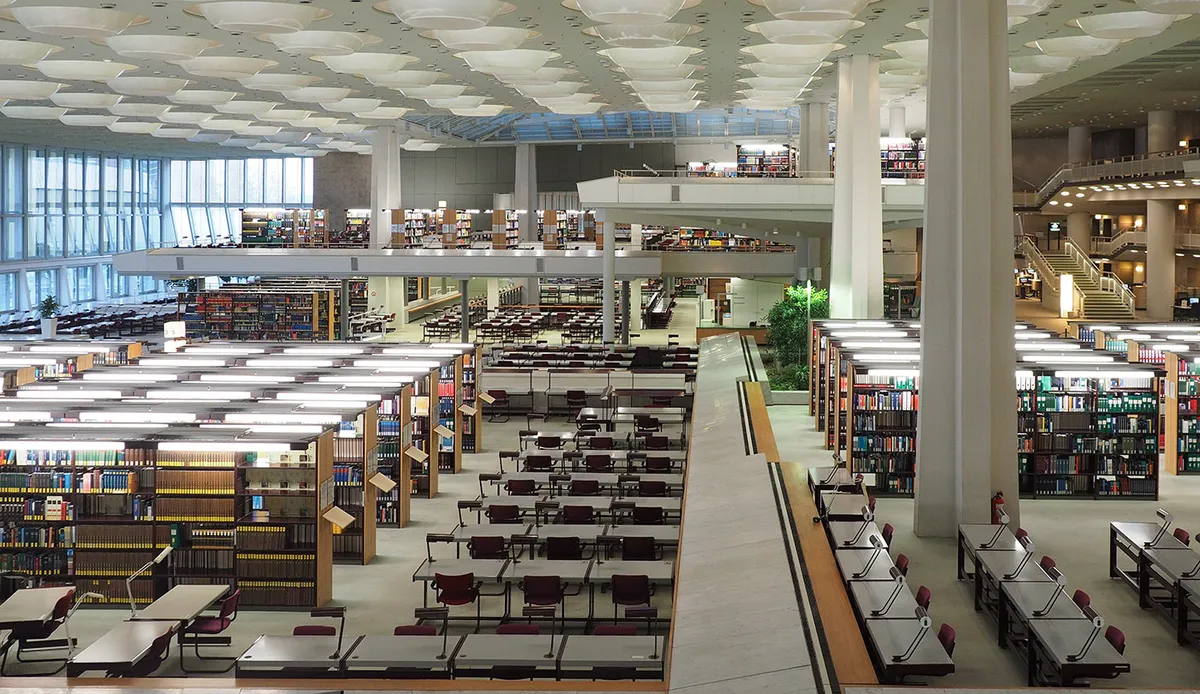
the library branch i go to is on potsdamer straße, part of the kulturforum in the western part of the city’s strangely barren but immensely imposing core. it is an enormous stone and aluminium shard laid on its side, swept backward to avoid being noisily intruded upon by a city centre motorway that was ultimately never built. one of the only analogues i have for its interior is the barbican centre, with its similarly dizzying array of intermediate hanging levels, wide and sloping connections, and monumentally scaled vistas across open communal space for bookstacks, reading desks, copiers and hang out spots, all arranged in heady continuity. it shares with the barbican the battered stone exterior surfaces and generous public lobbies before more secure, interior spaces are reached, but trades the opulent space age red carpet and brass trimmings for a more formal and functional stone checkerboard floor and modernist steel fittings from the tubular pillars, which set the rhythm of the space, to the integrated lamps on each desk. the other kind of structure it makes me think of is a military ship, both because it is unusually tapered despite its enormous interior shape, and because it is the kind of space that encloses a majority of its technical functions while spilling the array of its human functions into a scattered and slightly chaotic space of intermingling and intruding levels, zones and orientations. it matches the scale and drama of my mental image of a destroyer, even if it is far more influenced by sci-fi film soundstages and mecha anime than any direct understanding of naval vessels.
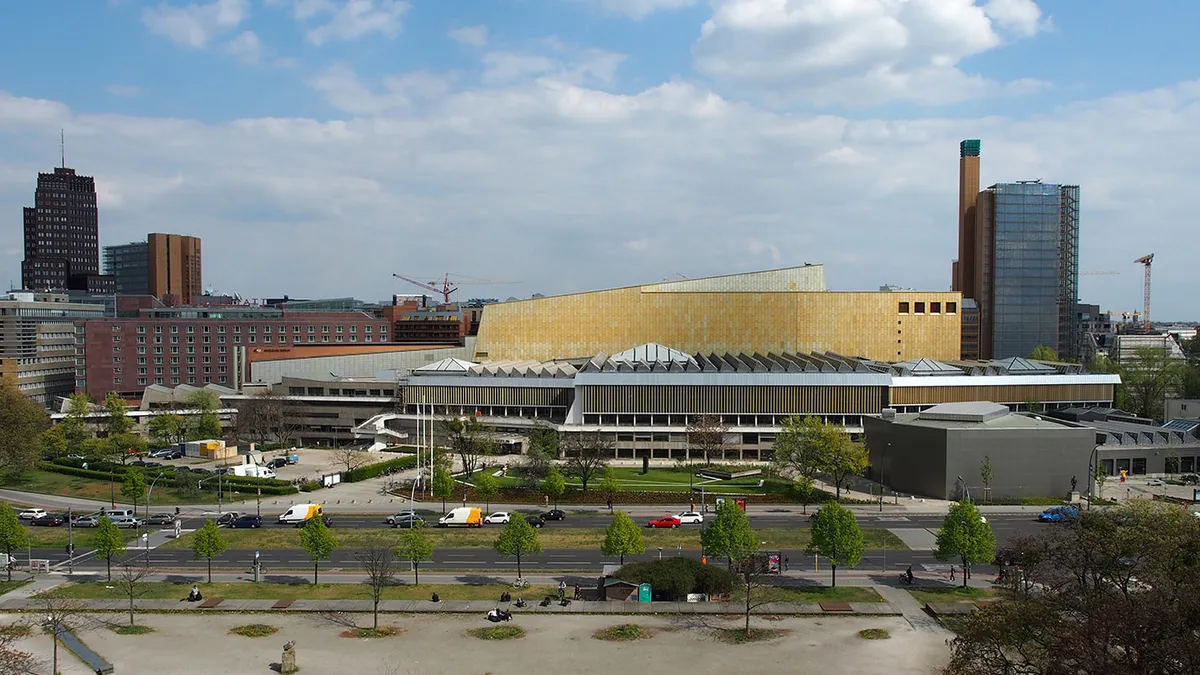
like the barbican, i feel the trace of an immense, postwar social democratic utopian project in the library. unlike the barbican, it is not a housing project; there are no streets in the sky or intermediate public spaces to knit it together, at least beyond a café that enables slightly more chatty working conditions. it is a destination in itself, more interconnected for people on its interior and more hermetically sealed from the city on its exterior. it is surrounded by a large arcing road which cuts it off from another iconic modernist building in the kulturforum, ludwig mies van der rohe’s neue nationalgalerie, a sunken glass temple surrounded by featureless concrete hosting the nation’s treasured modern art under the earth. a road tunnel and a casino hold at bay the rest of the commercial wasteland of potsdamer platz itself. i had a vegan burger in the mall there last week and was genuinely shocked the place wasn’t being colonised by rats.
i was listening to an early episode of the excellent architecture podcast ‘about buildings + cities’ and deeply resonated with the barbican estate being described as aspiring towards a georgian square: a distinctly urban form of dense housing, but turned inward and sometimes gated in order to generate a kind of exclusivity, peace and closed community. the barbican’s exception is that it adopts a marginally more egalitarian ethos than its historical antecedent, hoping to house the proletarian workforce of the city’s finance industry, rather than its moneyed elite.
instead of a georgian square, the potsdamer straße library makes me think of a laboratory. a collective space of individual endeavour, with a vast infrastructure of hardware and personal amenities arrayed about, but ultimately a site of work that should be arrived at, toiled at, and left. a laboratory for the humanities does indeed sound like a beautiful utopian vision, but the proximity between it and a battleship, or open-plan office, is disquieting even as it is very effective at getting me to do my fucking thesis writing. the library’s egalitarian ethos begins in the belief that everyone should have access to beautiful, monumental and well-provisioned public space, and ends in the demand for its solitary use. the more recently renovated branch of the library on unter den linden has moved to rebalance this by offering conversational zones and bookable meeting rooms; amusingly it is retrofitting what is still resolutely a prussian neo-baroque palace. i like it too, but it does not have the sheer scale of the potsdamer straße branch, which is where i’ve ended up ordering all my books. there are also fewer undergrads hoarding the desks as there is no massive university next door, thankfully.
the purpose of this exercise is more or less to prove to myself that seeing and using a city in action, learning its processes and structure, is a clue to its historical arc. the problem is that london seems to have stopped having a history. it is building a vast quantity of gormless international-style towers in the city having already saturated the docklands, and failing to advance itself in basically every other sense. london speaks with a plethora of voices, all of which have a vocabulary that is stunted in 2003: the gherkin was complete, the postmodern experiments in the periphery of the docklands were played out once yuppyism was outmoded and basically everyone concluded we were done being silly. i know this is a steep generalisation, but all i love about london’s contemporary planning is mostly just the overground and elizabeth line, given everything else (most notably the 2012 olympic developments) have an infuriating sense of impermanence and half-measure about them. there is no desire or vision for monumental or civic function beyond the bare minimum. efficiency, minimised cost and integration into a fabric which has already been established and calcified seems to rule above all.
if i seem like i am trying to suggest that history feels like it has stopped in london, i kinda am. the counterpoint is that i am not sure if it really stopped when everyone agreed (i guess when the berlin wall came down lol), or if it stopped with the grinding halt of the postwar socdem dream, or if it stopped when the miner’s strikes were smashed. one of the joys of the last few months has been listening to an enormous quantity of episodes of the dig podcast’s backlog. there are a few long series that i have spent many rewarding hours with: first, thawra, the enormous chronicle of anti-colonial, national liberation and radical left political struggles in the middle east, vast in scope but still centrally concerned with palestine. this was followed by a shorter series from a few years ago about the modern political history of iran, and finally a shorter two-parter on a book on the rise and fall of opec as a political and economic bloc. throughout the course of each series, i could feel a divergent reaction within me to the various roles that britain seemed to occupy in the narrative: arrogant and comfortable as colonial overlord in palestine, iraq and the trucial states, merely content as rentier and commercial overseer in suez and dubai and the oil fields of abadan. what was more shocking, sometimes coincident with the american ascension to hegemony and sometimes long outlasting it, was britain’s violent, thrashing interventions into the world-system. britain seems to play a decisive, tragic hand in a number of crises that it directly precipitates: in the bungling of the suez crisis which effectively ends their regional security arrangements through the ascendence of nasserist pan-arabism, in iran through the coup of mossadegh which indeed temporarily secures BP a lucrative oil extraction concession and otherwise sets the country on a path to clerical revolution, and finally, maybe more subtly, in the cracking of the oil crisis in the early 80s by the massive expansion of north sea oil drilling.
i am used to britain-as-backwater, sliding into a series of ever more nostalgic visions of the imperial past with whatever material remnants of that legacy being eroded by the movement of far structural factors upon which it has been, for many years, a passenger. if the tripartite aggression ripped out what was left of britain’s commercial heart, then the financial crisis more or less did the same to its financial circulatory system, and the self-imposed austerity chopped off whatever remained below the shins. i see evidence of britain’s mutilation in the fabric of the physical world, with examples far too numerous and pervasive to bother trying to list. i would love in due time to see the renovated the british library - apparently there’s a billion pounds to be poured into it! - knowing full well that the powers that be could not even conceive, let alone countenance a new terminal railway station across the road at euston. everything is crumbling, first slowly and then fast. ‘we can’t have nice things’ is somewhat true. we can have nice things that sustain the minimal components of the reproductive infrastructure of capital, with a curvy and sustainable timber roof this time, if you're lucky. we can also brush off the surfaces of these maybe misguided and insufficient utopian postwar visions once in a while, only to learn how hated they are, as wasteful and un-british and impersonal and ‘brutal’, as ironic it may be given their unashamed humanist, civilising mission. it is disjunctive to see britain kicking, though in some sick sense the fact that the scale of its ability to cause catastrophe is undoubtedly diminished is some kind of relief.
berlin does not feel like it has stopped, however. i feel like i am seeing it turn its guts out every evening as the train service slows to a crawl and the construction work begins. every effort over the last 30 years in the city has been to stitch some kind of patch over the immense scar left by all the history happening here, sometimes successfully and sometimes in a hysterical, denialist fever pitch. i know the oomfs appreciated me posting about the berlin palace: originally the home in the city of the prussian monarchs, it was built (to the extent that one can say a continually expanding enormous palace has been built) in 1443. it was razed by the DDR government and replaced with the seat of government and a civic and cultural heart for east berlin and east germany, the palast der republik. lasting a mere 14 years in regular use, it was indeed riddled with asbestos and decomissioned just before the disestablishment of east germany as a political entity. however, it was not remediated after unification (something that will start at the library very shortly), but demolished to make way for a reconstruction of the old prussian palace, which now sits as a behemoth on the island in the spree.
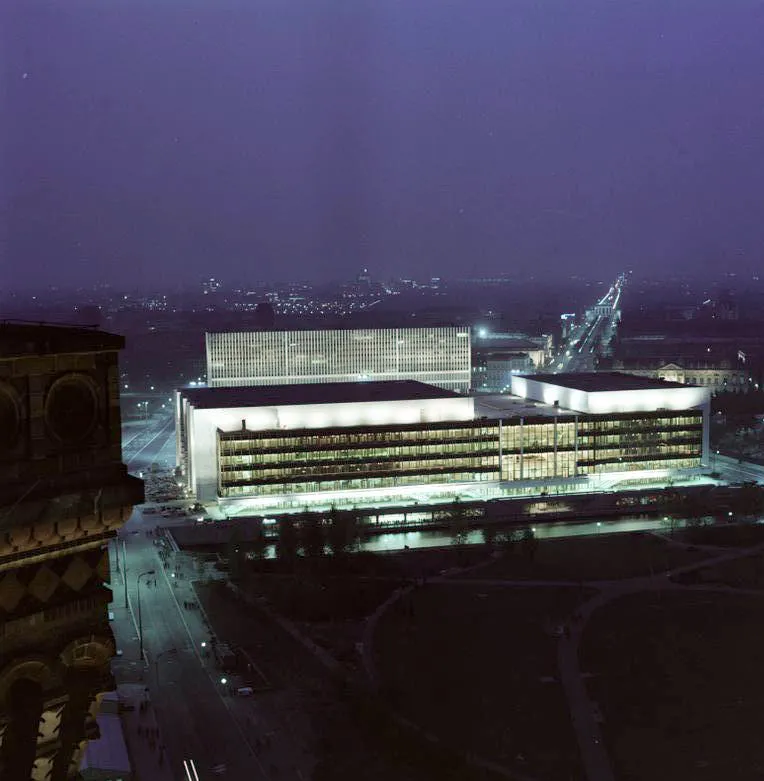
there is no mistake that unlike the barbican and the potsdamer straße library, some kind of revolutionary potential is suffused in the modernist design and ethic of the palast der republik, a unification of the political and cultural life of a real socialist project. it had to be destroyed to make way for a monument to the previous acceptable guise of a unified germany, a national-conservative and high imperial vision of the state. it is a vicious and calculated act of forgetting, imposed on the city and its residents. as curator and researcher MaryKate Cleary writes:
does the removal of the Palast from the urban landscape alter the collective memory of former East Germans? As quoted by [William J.V.] Neill, Mike Featherstone argues, in regard to the abrupt absorption of the former East into the government of the West, that “all sense of continuity between past, present and future [was eroded] – all belief that life is a meaningful project”
berlin is a city tortured by history, reliving that torture in its pointed and aggressive forgetting and reconstruction constantly. it polices the geographical consequences of segregation, it gorges itself on the carcass of the artistic and cultural life that grew and atrophied in its old shell. it puts its great civic institutions in baroque prussian palaces, some constructed by actual prussians and some recreated by the new germany. it is keeping its wounds fresh.
i live in one of the vast number of wilhemine-ring altbaue. the other building on the block has a sign outside saying it was built in 1902 and renovated in 1970. it is in an industrial area which used to be the core of its manufacturing explosion: osram, aeg, siemens and many other corporations placed their factories along the rail and river connections at the edge of the city, and built the immense residential complexes that now fill the blocks. there is still a massive siemens gas works at the one end of the neighbourhood; a couple weeks ago in the local station i was waiting on the platform next to two guys in siemens jackets, one of whom was wearing a bundeswehr beanie. i didn’t know the bundeswehr had merch.
the district grew with its industrial capacity, producing the first modern hospitals in the city, including the workplace of robert koch, and a law court and jail complex, amid the factories and tenements. it is archetypical of industrial, rapidly expanding berlin in spatial and architectural form. though many of the factories are gone, i can still see wholesalers and shipping container yards from the front of my building. there are gashes in the grid that i am certain are the result of allied bombing of a crucial industrial and logistical node - they have occasionally been patched up with post war construction or left as strangely oriented linear parks.
the form of these altbau buildings was generally set according to the architectural vision of the hobrech-plan, a massive urban master plan devised in 1862, that was used for both the construction of the housing for the rapidly industrialising city and also its postwar reconstruction. it should be said - the scale of destruction and human misery in berlin vastly exceeds anything that (for example) london experienced; half a million were killed in the soviets' battle to capture the city, and in the order of one million people in the city were homeless at the war’s end. while the development of each part of the city bears the unmistakable marks of their location on each side of the wall in the subsequent half-century, much of the reconstruction work across the city was to repair the grid of altbau housing as quickly as possible. the hobrech-plan lives on.
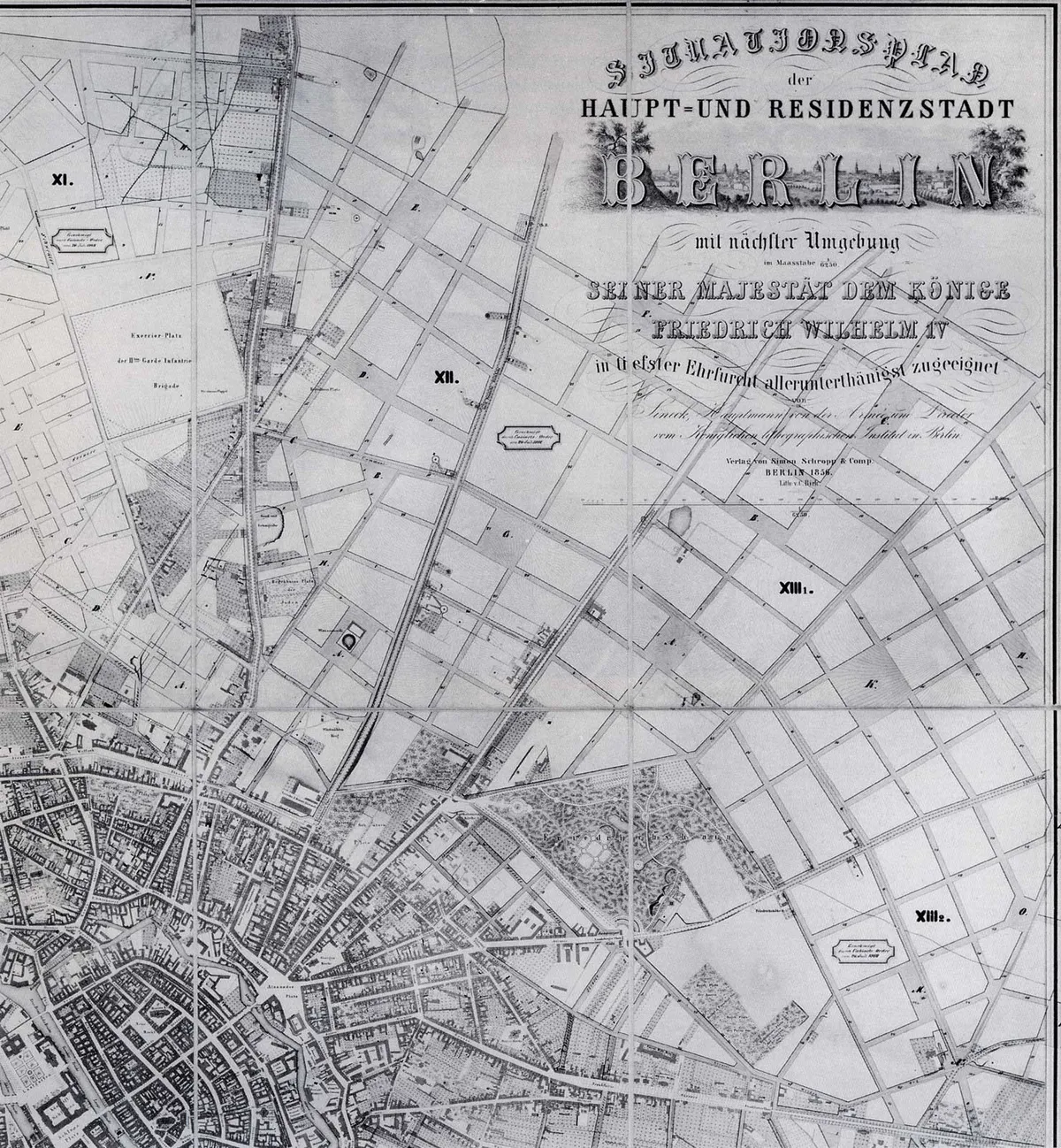
the classic form of these buildings generally consists of four- or five-story residential buildings arranged in a u-shape, with a front, side and back building. each faces inwards on a courtyard which collects the mail and waste services, as well as allowing access to the cellars. i expect in the past that would have also included toilets, though i can also see remnants of these on the half-levels in my own building. these buildings were once to be crammed to the brim, comparable in density and squalor to any vision of victorian london, though many apartments have since been broken through or expanded to create viable homes for contemporary residents. the form of the building is consistent in shape and style throughout the city. one exception comes in the former east, where many of their ornamental wilhelmine facades were stripped off to leave a kind of retroactive bauhaus functionalism, mostly rendered confusing and unbalanced given the windows on the surface no longer have the lintels they were designed around.
i love this apartment. i love its old quirks and old wooden floor and the unencumbered closeness that feels utterly natural to the visual and spatial design of the city. i also love the architectural form, which is private and quiet yet serviced well and deeply connected to the city. i love that this form is projectable and replicated in so many places. i know of nowhere in london that contains centrally located, distinctly urban but self-contained housing at scale. i know of georgian townhouses in private squares, which serve the old elite fraction. i know of the barbican, and that is a glorious success as a cultural monument and abject failure as a model for mass housing development. the altbau is not revolutionary. it is just, or at last has become, good mass housing. coincidentally, i think it breeds a kind of surveillance fetish that might just be part of crotchety older berliners’ mentalities, but seems to be inevitable when everyone shares core access and service functions and stares at eachothers’ half-closed curtains whenever they are home.
i think this city has a vibrancy, a vibration, that comes from its many unresolved tensions. it has an explosive and globally networked cultural life contained by the overbearing presence of a frankly embarrassed state. it has the most intense objects of imperial and nazi legacy suspended, unmetabolised, in every corner of its landscapes. it has ended up condensing the contradictions of “europe” as a continent with extraordinary intensity, sitting as it does as fulcrum between east and west with outsized cultural and political representation for each camp and none of the resources to resolve their tensions: the city's two disused airports, tempelhof and tegel, are housing an enormous number of (mostly) ukrainian refugees. if you travel 20km out the city, the majority votes for the afd and thinks the city is full of decadent faggots and thieving immigrants. it struggles to be itself because it is transfixed by its role as mediating centre for a dead socialist order and its slowly dying industrial capitalist replacement. it wants to be a coherent home for a political project grossly undercut by the concrete activity that makes the city move.
i know that the uk is the butt of a panoply of jokes right now, but the questions ("how can we face the future? who are we doing it for? can we afford to? can we afford not to?") that prompt belly laughs in one context seem to draw out anxious chuckles and beads of sweat on foreheads in others. where the uk seems to have given up, germany is thrumming with anxiety. it is a productive anxiety: it forces train stations and libraries and museums and palaces to be built and rebuilt. some of them are remarkable, some of them are asinine, all of them are symptomatic. the city houses my friends in these old buildings and they will crack and crumble at the edges but they will work in ways that other cities will not. the things the city offers will never be enough to satisfy what is owed to the world. its symbolic economy churns because the real economy must too, and both are indifferent to history even if we, the people subject to its decisions, are not.
in some part i want to tether this to the big upheavals happening right now. but i can only read speculatively about the subjective impacts of china’s recurrent waves of industrial, residential and civic construction even though i know they must each be epochal: i have read my tooze blogs and my chuang dossiers and still know i am lost. i am cautious of even thinking about referencing the soviet union's own modern upheaval and urban transformations, the city of moscow hanging with even more phantasmatic weight in the back of my mind. most pressingly, other than a couple transit videos i know nothing about how the city of minneapolis works, is laid out, is surviving and resisting in the midst of ice’s chokehold.
i also know that the physical destruction of gaza is the kind of tear in history that cannot be rectified, but the architectural standpoint is one that can, maybe, start to account for it in the limit. i first visited berlin a mere couple of months before october 7th, and while i was there (mostly for an academic conference) i visited daad gallery, which was hosting an exhibition by palestinian artist, architect and researcher saba innab. it was entitled Tread Lightly – Leave no Trace; for what it is worth i know from a friend that this exhibition was a struggle to put on in its actualised form thanks to political pressure even before the genocide started, and i have even deeper admiration for it now that i know this. the exhibition consisted of architectural models, plans, and fragmentary reconstructions of palestinian homes in the process of dispossession or de(con)struction. an architectural gaze puts the colonial gaze and its simultaneous fantasies of elimination and integration into relief. these homes are just space, to be mapped, and valued, and bombed, and built over. the blank grid is the weapon of primitive accumulation. when the israeli assault on gaza broke out, the research collective forensic architecture started to use a range of detailed geospatial and technical means to plot out the sequences and spatial processes of mass destruction and deathmaking. remember when it was a shock that they would bomb a hospital? that fact checkers were arguing about whether this single bomb had been dropped in the carpark or the street over? do you remember the name al-ahli?
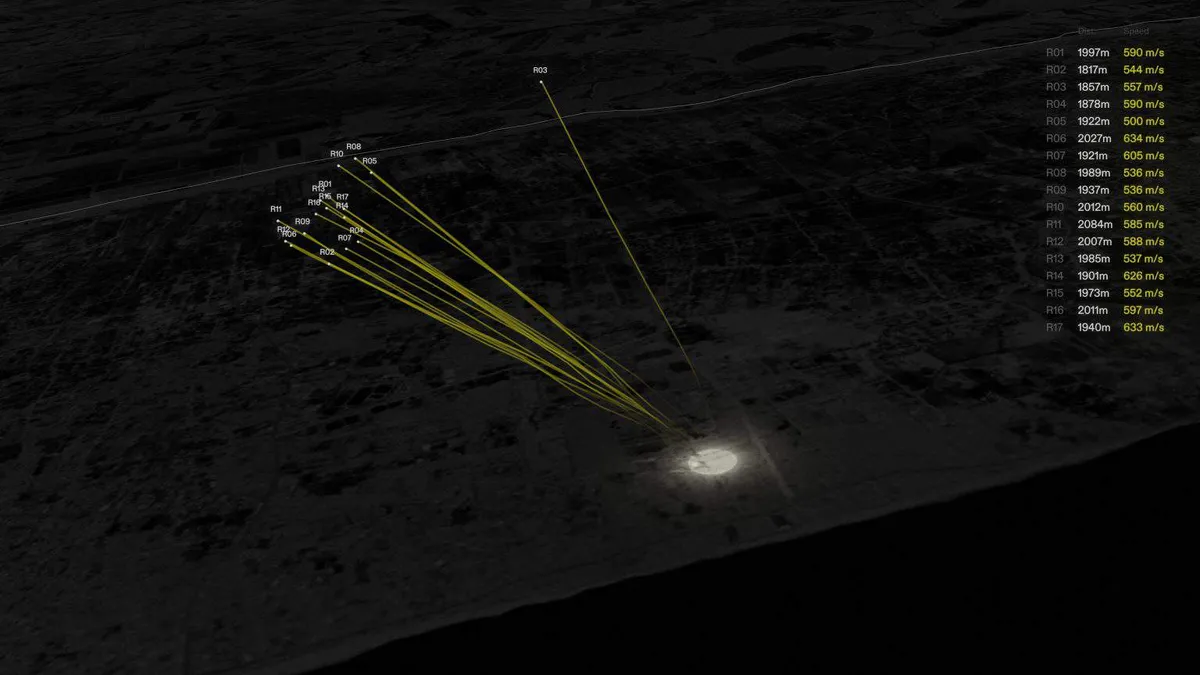
forensic architecture’s style is arch-technological. the maps are slick and interactive, the tools are dynamic, animated and excessively detailed, the look is dark-mode black and grotesk fonts. i always laugh at how the cia’s 2021 rebrand wholly adopted this style. i have no doubt that berlin techno parties played a role in its global circulation. the reconstruction of bomb trajectories and building facades in forensic architecture’s local work has the same modularity and specularity as innab’s presentation of homes: fragments are suspended in a moment and shorn of their materiality so they can hang still enough to tell us their story. the real building is a pile of rubble and there are bodies underneath it. innab’s work seemed so shockingly prescient given that the only ways to convince and argue and confront the lying and denial about israel’s actions was to deploy the same abstractive technological view as what i am sure those firing their artillery saw, and quite nearly the same as the insane ai-accelerated vision for gaza’s reconstruction as colonial resort. i am frankly relieved that grok doesnt have a fucking clue how to use autocad. i remembered the way i felt looking at innab’s forms: a deep despair that i will relate to these forms in a merely analogical, stunted way compared to how people who live in gaza relate to their homes, and hospitals, and universities. i can only project, from knowing how the built environment offers both the durable infrastructure of life as well as a crystallisation of our history and aspirations, how to even begin to comprehend the complete destruction of a place. i still cannot, i can only grasp clues.
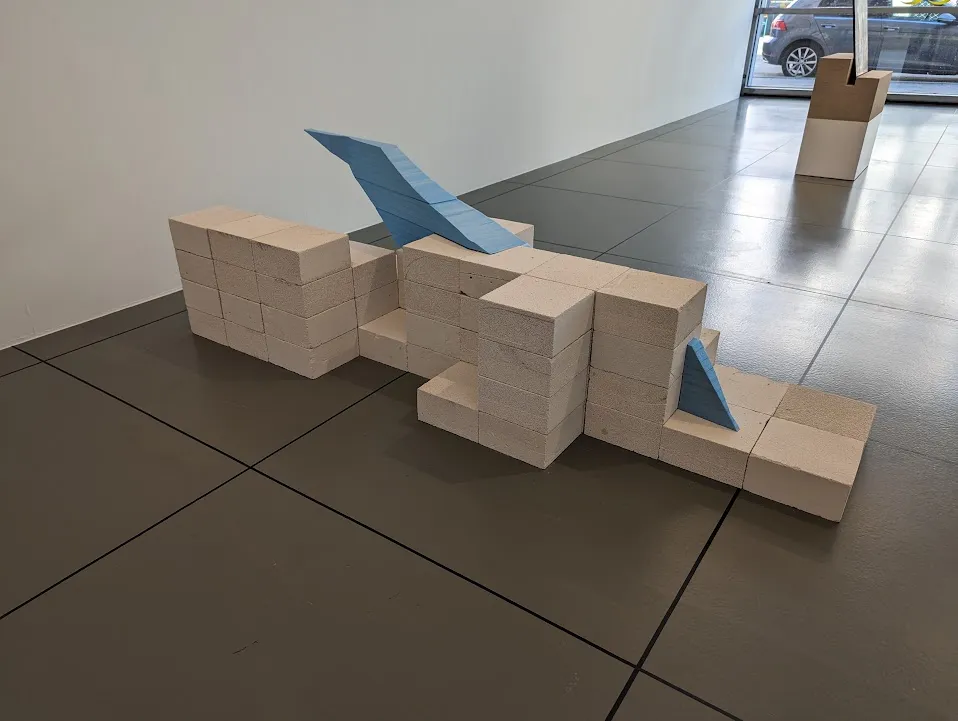
one of the works in the exhibition is a pale blue shard piercing a building. i believe it was a manifestation of a rocket trajectory and the destruction it wrought on a structure, intruding and snaking in at an oblique angle. on the wall nearby is printed "BASED ON A VERTICAL SECTION OF A TYPICAL PALESTINIAN PEASANT HOUSE, REDUCED TO A SPECULAITVE SCALE OF A TUNNEL". i think about it, the overturned shard or handaxe, whenever i am at the potsdamer straße library. they are not the same object, they are inflected with different histories and locate different shattered dreams. the library is still standing and its remedial work, to remove asbestos and other hazardous substances, will be commencing soon. i have a thesis to finish.